

Help shape the Yukon’s mining laws
Written by Randi Newton and Paula Gomez Villalba | April 8, 2023
As new (deeply overdue) mining legislation is created, the Yukon government is looking for public feedback. We put together our thoughts on the approaches being considered and the need for mining reform.
How to take the survey:
Go to ygsurvey.yukon.ca/surveys/2023-minerals-legislation-survey
Select the parts of the survey you want to complete. Our recommendations below are based on the approaches put forward in the Discussion Document and focus on:
◻ Mineral tenure – disposition and acquisition
◻ Mineral tenure – maintenance
◻ Financial Security
◻ Royalties
◻ Reclamation
You can use our recommendations as a starting point to draft personalized comments, or copy and paste them into the survey boxes.
Some of these topics may sound jargony but they link to core ideas that matter to everyone: honouring rights and values, taking responsibility, equitable sharing, and treating the land with respect.

In the Dawson Region, for example, mining claims are determining which parts of the Fortymile caribou herd’s range receive the strongest protections. While the draft land use plan safeguards the heart of the herd’s range in Wëdzey Nähuzhi/Matson Uplands, the boundaries carefully avoid quartz mining claims, leaving the herd’s critical migration route at risk.
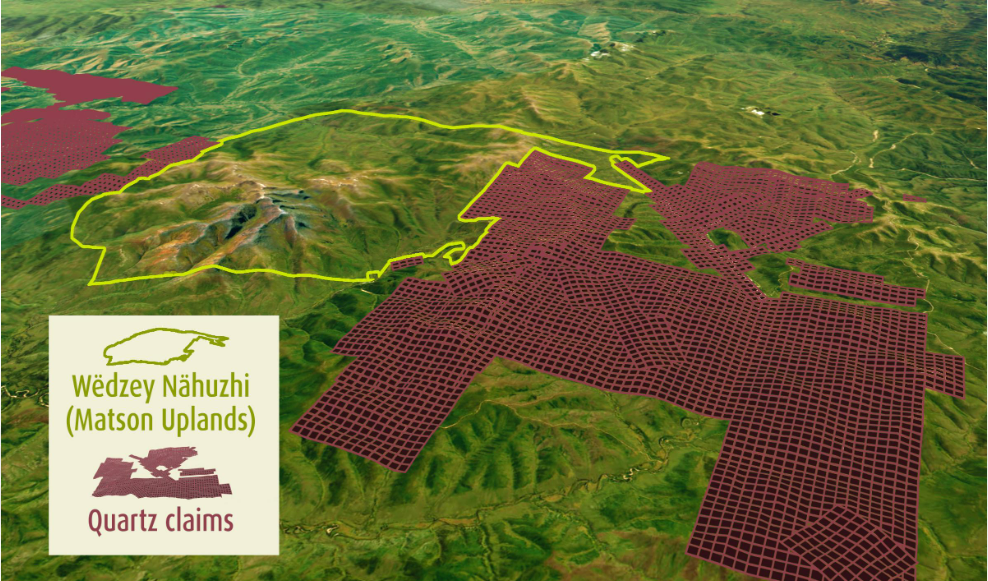
Map and photo by Malkolm Boothroyd.

Survey Question 2.1: Do you have any thoughts or concerns about the approaches we’re considering for disposition and acquisition, or additional things that you think we should consider?
Yukon government’s discussion document recognizes that “mining is not always the best use of land.” Reforming the free entry system is long overdue, so any of the potential approaches would be an improvement. I believe approaches that allow for governments to approve or deny claims before they are staked would best protect other values and rights. We need a new system that considers other uses for the land before areas are destined for mining. First Nations should also have a say in where mineral staking happens in their traditional territories.
You can use our recommendations as a starting point to draft personalized comments, or copy and paste them into the survey boxes.
Mineral Tenure – Maintenance 
The Yukon does not have a framework to take back (expropriate) mining claims when they become incompatible with other plans for the land, like new conservation areas. Our system relies on the courts instead of having clear rules and expectations for compensation. The resulting uncertainty can make the Yukon government hesitant to designate an area for protection, even when ecological and cultural values clearly outweigh mining values.
Survey Question 3.2: How important is it to establish clear rules for expropriation and compensation of mineral tenure?
It is vitally important for the new mineral legislation to establish clear rules for expropriation and compensation. The current lack of a clear pathway to protection is putting many ecologically and culturally important areas at risk. Land use planning needs to be able to designate protected areas without fear or uncertainty from existing claims in important areas.
You can use our recommendations as a starting point to draft personalized comments, or copy and paste them into the survey boxes.
Responsibility
Financial Security
Under the current mining laws, only some exploration companies and very few placer operators pay security to cover the environmental risks and cleanup costs of their projects. Hardrock mining companies are required to provide security but the Yukon has a long track record of underestimating security needed, leading to expensive taxpayer funded cleanups and environmental harm being left unsecured.
Survey Question 6.1: Do you think the approaches we’re considering for security will reduce risks for taxpayers? Please explain.
I urge the government to improve how they set security amounts by considering risks and the likelihood of successful reclamation. This will help cover potential costs and also encourage companies to take less risky approaches and develop better reclamation plans.
Requiring security for all projects (unless very low risk), including placer and exploration projects, would protect the public from having to cover reclamation costs if a company walks away.
I support the approaches that would strengthen accountability and transparency, including mandatory periodic security reviews, better public reporting, and tools for the government to collect security and take action if it’s not paid. The government should also consider the financial health of companies, and assess the risk of them not being able to pay increases in security.
You can use our recommendations as a starting point to draft personalized comments, or copy and paste them into the survey boxes.
Fair Sharing
Royalties
Royalties are how Yukoners can equitably share in the profits that mining can bring. We need fair and predictable royalty rates that also can help weed out particularly risky mining projects.
Quartz miners are currently only required to make payments once they start making a profit (but many have abandoned mines before making any payments), and placer miners pay just 37.5¢ per ounce of gold (the same rate as the early 1900s).
Survey Question 7.1: Do you have any thoughts or concerns about the approaches we’re considering for royalties for quartz mining, or additional things that you think we should consider?
The royalty system should favour robust projects over risky projects, promote equitable sharing of economic benefits to current and future generations, and provide stable benefits. A hybrid royalty system is the best way to meet all of these goals. Companies should pay a minimum royalty when mines open but are not yet profitable, and then a profit-based royalty once they reach profitability. I believe this system would provide stability while also allowing Yukoners and First Nation governments to benefit in times of high profits.
You can use our recommendations as a starting point to draft personalized comments, or copy and paste them into the survey boxes.
Survey Question 7.2: Do you have any thoughts or concerns about the approaches we’re considering for royalties for placer mining, or additional things that you think we should consider?
The placer royalty rate is currently far too low. It should be set at a rate that meaningfully contributes to the wellbeing of the land, water, people and communities.
You can use our recommendations as a starting point to draft personalized comments, or copy and paste them into the survey boxes.
Treating the land with respect
Reclamation and Closure
Mining transforms the land. Mountains are carved out and ancient peat is lost. Very rarely can the environment be returned to its original state.
If projects are allowed to go forward despite this transformation, there needs to be clear and achievable reclamation goals that are developed with Indigenous governments and community members, and checks to ensure promises are kept.
Survey Question 8.1: Do you think the approaches we’re considering will improve reclamation and closure outcomes? Please explain.
Several of the approaches being considered can ensure companies fulfill their reclamation promises. Progressive reclamation would ensure that environmental harm isn’t an afterthought or allowed to grow too large, especially if a site is abandoned.
I strongly support involving local communities and Indigenous governments in reclamation and closure planning. The government should always be able to require a plan if necessary, with full plans being needed for sizable projects.
I believe we need stronger tools to hold companies accountable if they don’t reclaim their site properly, like fines, bans, loss of tenure, and government intervention. Mine sites are complex and it’s impossible to fully predict costs and issues that will pop up after closure, so I agree that companies should pay a post-closure fee to cover these unexpected costs.
You can use our recommendations as a starting point to draft personalized comments, or copy and paste them into the survey boxes.
Update: Survey closed in May 2023 and the Yukon government has released a What We Heard report based on submissions. Learn the latest at our main mining legislation campaign page.